

The M2M group leverages engineering principles and biomedical expertise to develop computational models that aid clinicians in understanding the mechanisms of action – and potential failure – of both standard and novel biomedical devices. This is accomplished using proprietary codes that incorporate advanced numerical techniques and non-standard material models, enabling accurate predictions of device behaviour and performance in real-world medical applications. Our goal is to create in silico tools that inform clinical decision-making and support innovative design strategies.
Bio-absorbable implants
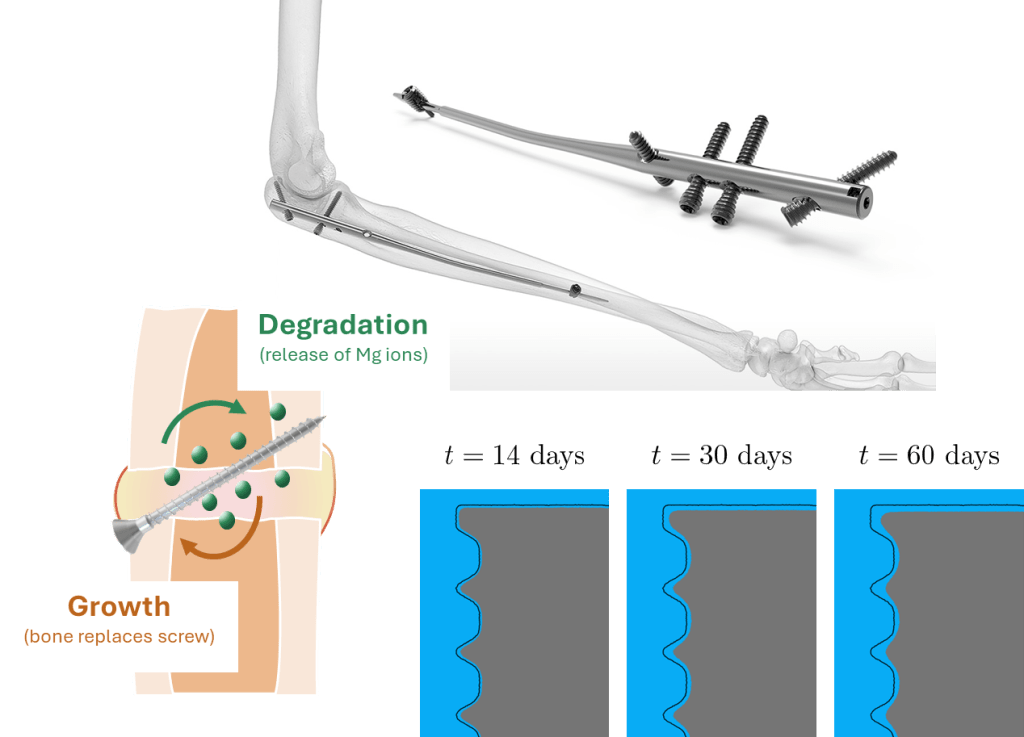
Degradation analysis of novel bio-absorbable bone implantsConventional surgery treatments of bone fractures use metallic plates and intramedullary nails that can lead to serious complications, including inflammation and systemic infections. As a result, implant removal is often necessary, but can be challenging due to natural calcifications that form during healing. To address these issues, novel bio-absorbable orthopedic implants have gained increasing attention during the past decade. Among available bio-compatible materials, magnesium (Mg) alloys offer a unique feature: their corrosion (i.e., degradation), occurring by Mg ions transfer from implant into surrounding bone, naturally stimulates new bone tissue formation and growth.
Clearly, this opens to the need of finely controlling the degradation rate of bio-absorbable implants. However, these devices are still a new product, and lack comprehensive clinical and experimental evaluations. We have therefore developed a computational model based on the phase-field method to investigate the degradation behavior of Mg-Gd screws in a corrosive environment. Our model has been validated against consolidated experimental evidence and theoretical results.