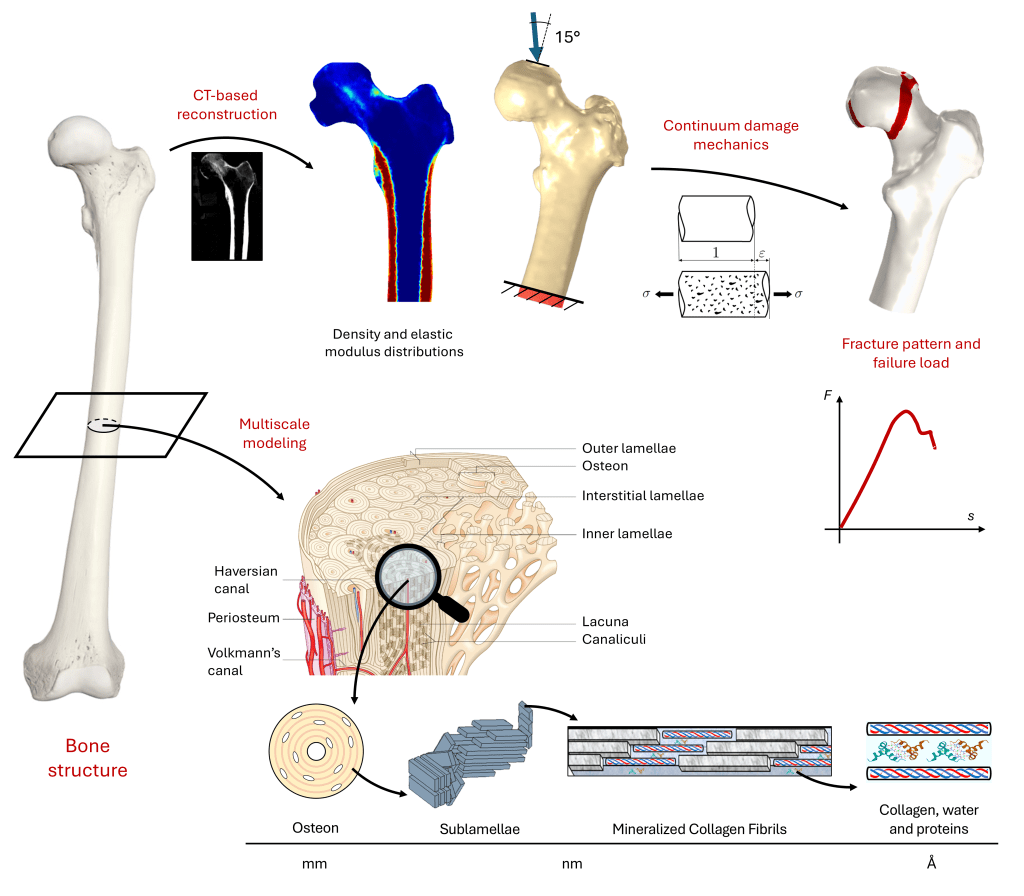
Our research group also focuses on the biomechanics of bone tissue at both the micro- and macro-scale. By exploiting in-house advanced computational models, at our lab we particularly aim at investigating how bone structure, geometrical features and mechanical properties affect the mechanisms of fracture propagation. Our work explores applications that can support clinical decision-making and enhance overall knowledge of the micro-scale mechanisms involved in bone fracture.
Computational modeling of femur fracture
Patient-specific in-silico models to assess femoral fracture risk.Fractures are particularly common in the femur, the primary load-bearing bone of the human body. The sharp rise in the number of fractures recorded over recent decades has become a major public health concern, since affected individuals experience noticeable reductions in mobility, independence and quality of life, along with serious medical complications. This issue also places a considerable economic burden on national healthcare systems. While accidental fractures (e.g., due to a fall) are often unavoidable, the risk of pathological fractures (those induced by medical conditions like osteoporosis or metastases) can be clinically assessed. However, current clinical parameters often lack specificity, as they disregard the bone mechanical determinants of fracture, such as exact bone geometry, functional loads, and local microstructure.
We are therefore developing a robust computational tool useful to support clinical decision-making for the assessment of femoral fracture risk, particularly in cases where traditional diagnostic methods are inconclusive. Using this tool, patient-specific analyses can be conducted in a non-invasive manner thanks to data acquired with Computed Tomography scans. Advanced computational techniques and mechanical theories allow us to simulate the progressive femoral fracture process. This approach enables us to assess fracture risk in advance by evaluating the load at which the femur is likely to fracture, as well as the resulting fracture pattern.

Osteon failure mechanics
Computational investigation on microcracks propagation in cortical bone.Bone failure at the organ level is profoundly affected by tissue composition and structural organization across various length scales. Within this framework, osteons, i.e. the microstructural building blocks of cortical bone, play a crucial role for bone toughening mechanisms. Thus, understanding the onset and evolution of macroscale failure mechanisms in bones requires an in-depth characterization of osteon fracture mechanics.
We have developed a consistent multiscale computational rationale describing osteons failure mechanisms that incorporates the histological architecture of bone tissue constituents starting from the molecular scale. Unlike phenomenological approaches, our structured multiscale strategy relies on physically meaningful model parameters. This allow us to predict in silico potential age- or disease-related physiopathological alterations in bone based solely on histological data and consistent experimental evidence.