

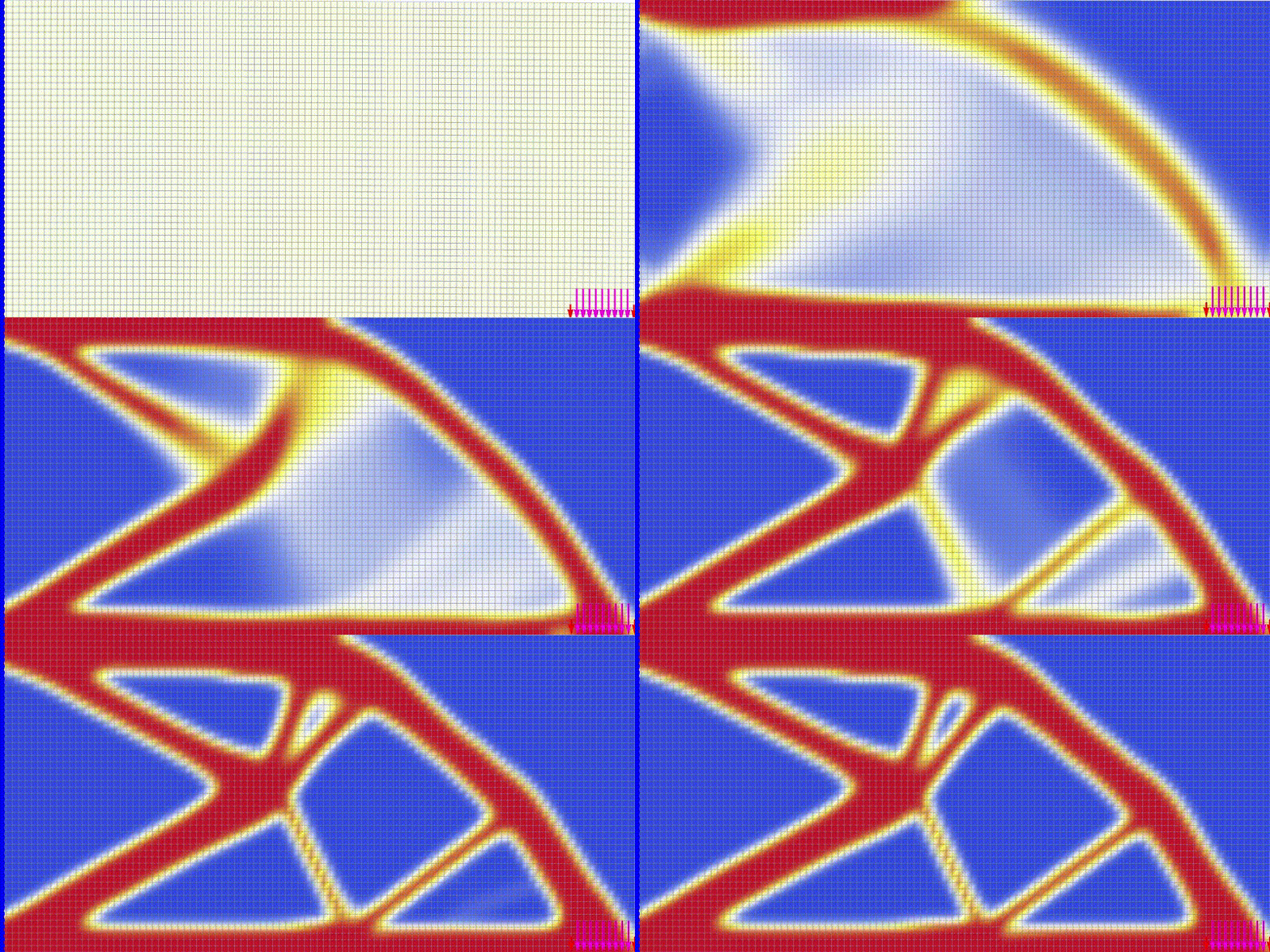
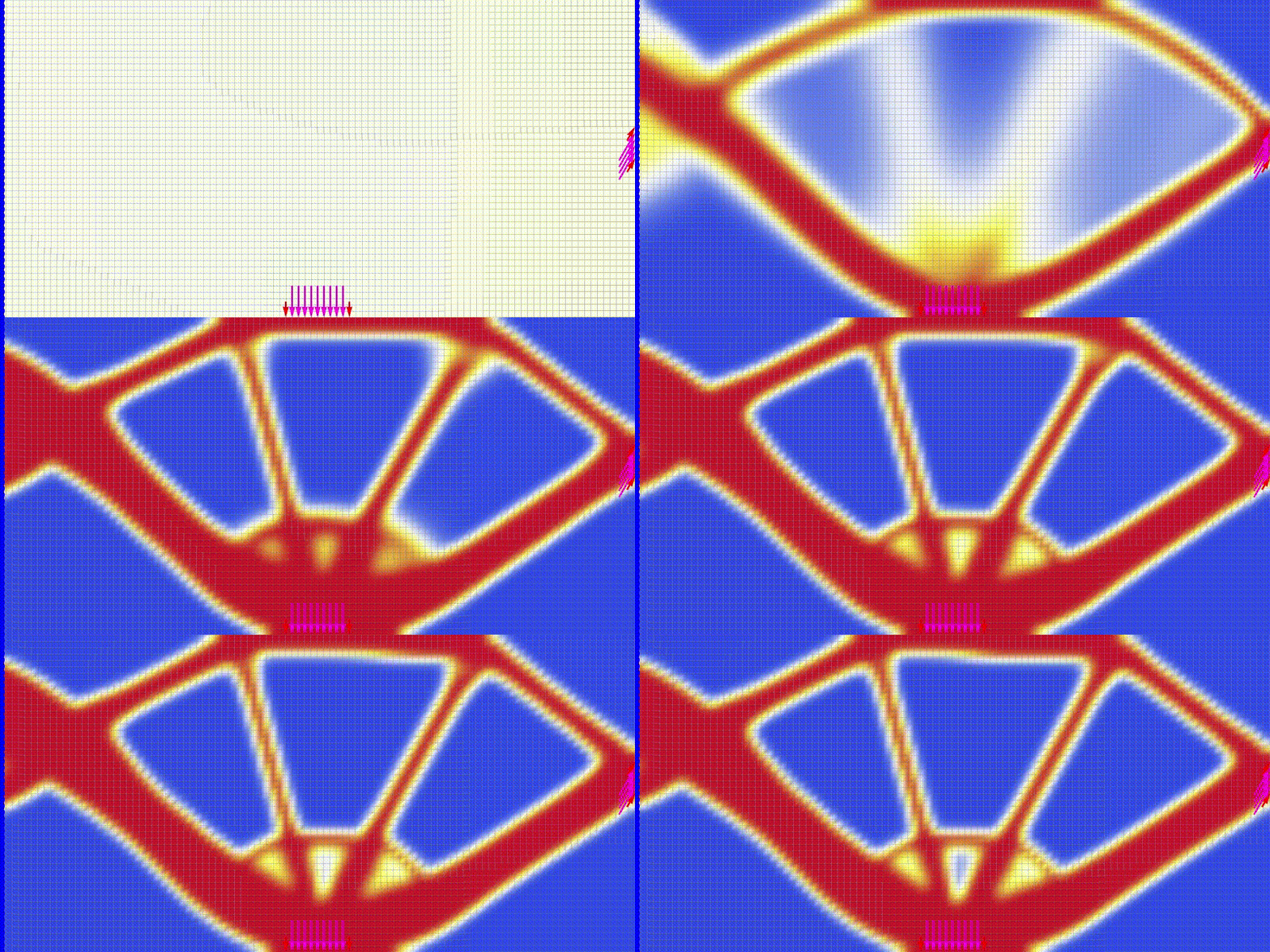
Structural topology optimization aims to determine the optimal material distribution within a specified design region, given an assigned load distribution and appropriate boundary conditions. Despite substantial progress in the field, ongoing research continues to focus on enhancing the robustness of numerical procedures, establishing rigorous proofs of the mathematical formulations’ well-posedness, and advancing user-friendly technical solutions to support cross-disciplinary applications.
Mixed and hybrid formulations: theoretical and numerical investigations
Insights from traditional and novel approachesWe have performed rigorous analyses on the fundamental properties of the phase-field approach to topology optimization, allowing us to optimize the solution strategy and settings of solution parameters. In particular, we have introduced a mixed formulation based on the Hu-Washizu principle allowing for a Simultaneous Analysis and Design (SAND), where the design variable evolves under the respect of equilibrium at each computational incremental step. This approach is proven to outperform the traditional Nested Analysis and Design (NAND) strategy, a staggered approach usually adopted in this field.
Moreover, we advanced a strategy combining the phase-field approach to more traditional filter-based solutions like SIMP. Existence of minimizers is proved and rigorous parameter asymptotics are discussed by means of variational convergence techniques. Numerical case studies show the advantages of the proposed combined strategy.


These activities are done in collaboration with the University of Pavia and University of Vienna.
Towards architectural applications
An Ease-to-Use Working Space for Modelling and DesignThe transition from optimized topologies to geometric forms suitable for the architectural design is complex, as it requires the reconciliation of structural criteria with aesthetic and functional aspects of con- temporary architecture. For this reason, topology optimization is still applied only sporadically in architecture, involving complex solutions designed for individual projects, lacking universally applicable design methodologies and tools.
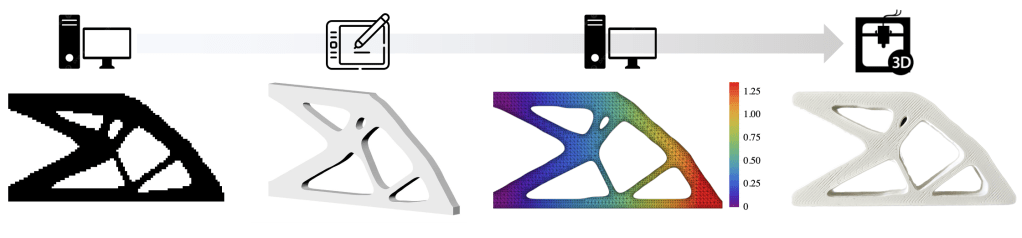
We then proposed a design methodology based on graphic interpolation and the use of parametric tools with visual coding to facilitate the introduction of innovative structures based on topology optimization in the architectural field. We demonstrated the advantages of such an approach in the realization of parametric structural elements (e.g., beam, joints, panels) and applied it for the conceptual design of a pavilion that combines panels for optimal structural and shading criteria.

This work is done in collaboration with Prof. Ilaria Giannetti and Andrea Cutroni.